
By Nicole Lasquete/OCTOBER 30, 2026
IFA has long relied on the trained eye of the laboratory professional. For decades, indirect immunofluorescence has provided valuable visual information for detecting autoantibodies, particularly in ANA testing. But as testing volumes grow, manually examining and documenting every fluorescence image can place increasing demands on laboratory teams.
Research found that automating indirect immunofluorescence can reduce intra- and inter-laboratory variability while supporting higher workflow throughput.
That does not make the microscope less important. It changes what the microscope can do.
An automated microscope can capture and organize fluorescence images consistently. This helps laboratory professionals spend less time on repetitive image acquisition and more time reviewing findings that require their expertise.
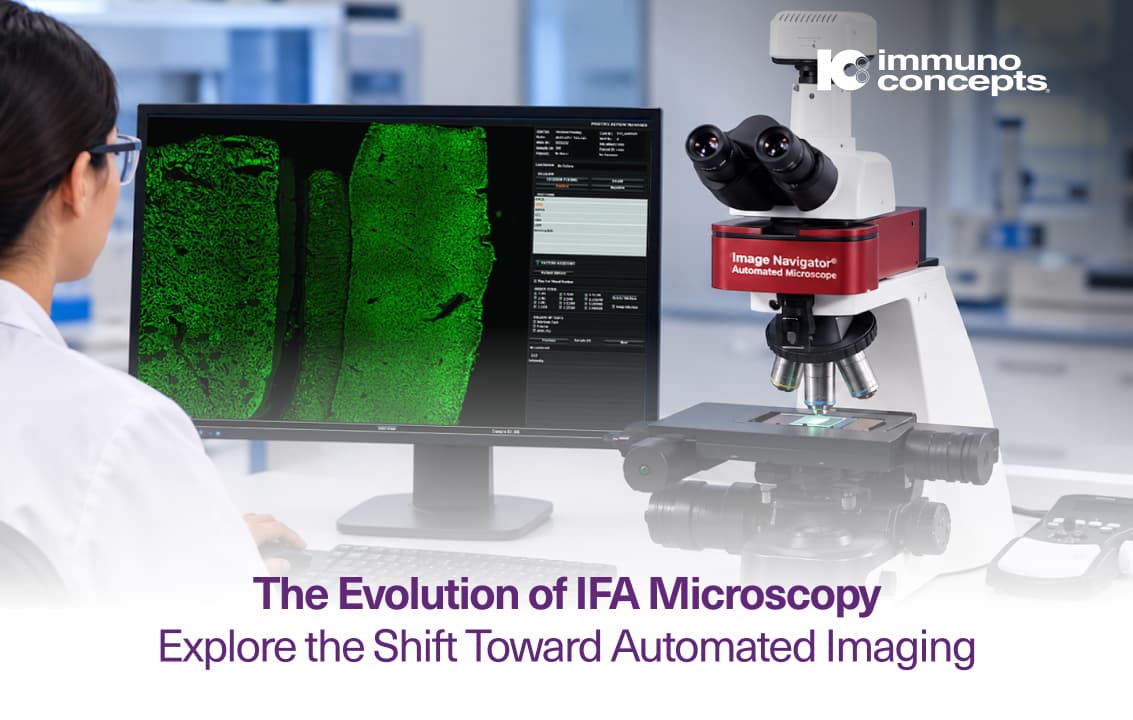
This is where Image Navigator® from Immuno Concepts fits into the modern IFA workflow. Designed specifically for IFA testing, Image Navigator® combines automated fluorescence imaging, image sorting, digital review, pattern assistance, and laboratory connectivity in one system.
Why Is IFA Microscopy Moving Toward Automation?
Manual IFA microscopy remains highly dependent on the experience of the person performing the reading. Differences in visual interpretation, fluorescence intensity assessment, and pattern recognition can contribute to variation between readers and laboratories.
A multicenter study found substantial inter-observer variability in ANA IIF interpretation, highlighting the challenge of achieving consistent assessment across laboratory professionals.
This is one reason automated microscopy has become part of the broader discussion of laboratory automation in clinical laboratories. The goal is not simply to make testing faster. Automation can help create a more standardized process for image acquisition, organization, and review while maintaining professional oversight.
For laboratories handling increasing IFA volumes, this can make a meaningful difference. Instead of manually scanning every slide and searching for relevant fields, an automated system can capture images systematically and organize them for review.
What Is an Automated IFA Microscope?
An automated IFA microscope automates key microscopy tasks in an indirect immunofluorescence workflow.
A conventional fluorescence microscope relies heavily on manual operation. The laboratory professional positions the slide, searches the relevant areas, adjusts the field, evaluates fluorescence, and records the findings.
An automated IFA microscope adds motorized movement, automated image acquisition, digital image storage, and software-assisted organization to that process. These capabilities can help standardize repetitive microscopy tasks while giving laboratory professionals a more structured way to review fluorescence findings.
The distinction is important: automation can assist with image acquisition, organization, and review, while the laboratory professional remains responsible for interpreting the findings and confirming the result.
For a deeper look at how IFA testing works, see our guide to immunofluorescence assays, which covers the principles, workflow, and interpretation of indirect immunofluorescence.
How Does Image Navigator® Work?
The value of an automated microscope becomes clearer when you look at what happens after you prepare the IFA slide.
1. Slides Are Loaded Into the System
IFA slides are prepared using standard Immuno Concepts reagents and kits. Image Navigator® is designed to work with these slides without requiring special reagents or proprietary consumables. The slides can also remain available for manual reading on a standard fluorescence microscope when needed.
2. Images Are Captured Automatically
Once you load the slides onto the motorized stage, Image Navigator® automatically acquires fluorescence images across the slide. The system uses LED fluorescence illumination and captures multiple high-resolution images per well, with image acquisition taking less than four seconds per image.
3. Images Are Organized for Review
Image Navigator® sorts captured images into possible positive and possible negative categories, helping prioritize images for laboratory review.
Immuno Concepts reports greater than 97% precision for this positive/negative image sorting function. This can help reduce the amount of manual screening required during routine IFA review.
4. The Laboratory Professional Reviews the Findings
This is where the laboratory professional's expertise remains central.
Image Navigator® provides a digital review environment with pattern libraries and ICAP integration to support fluorescence pattern interpretation. The system also includes tools for titer review and result prioritization.
Automation therefore changes the mechanics of image acquisition and organization without eliminating the interpretive role of trained laboratory personnel.
What Can Image Navigator® Improve in the IFA Workflow?
Once image acquisition and review are automated, the value extends beyond the microscope itself. For the laboratory, the larger benefit is how those capabilities can fit into routine testing, documentation, and information management.
Image Navigator® supports several practical aspects of the IFA workflow.
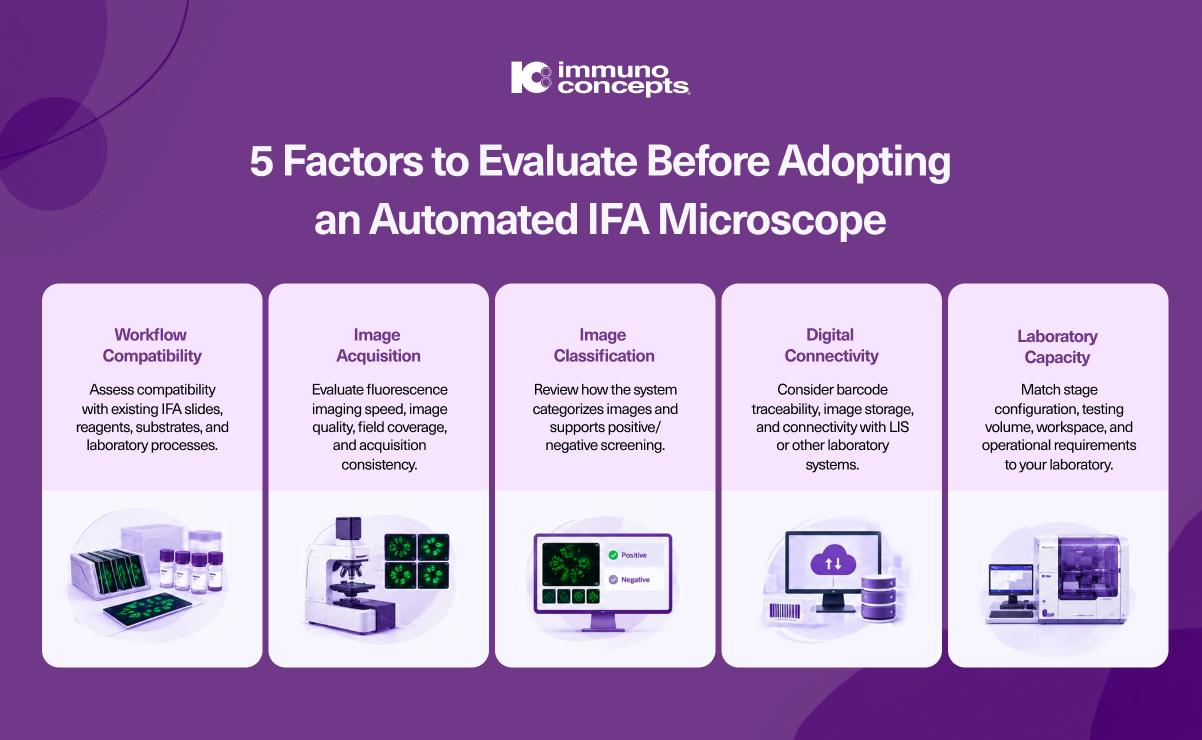
A more organized review process: By sorting images into possible positive and possible negative categories, Image Navigator® can help laboratories structure routine image review and direct attention where further evaluation may be needed.
Greater traceability: Images are stored with barcode traceability, creating a digital record associated with the testing workflow.
Workflow connectivity: Image Navigator® can communicate with connected LIS hosts and automated pipetting systems, supporting a more connected IFA workflow without requiring middleware.
Flexibility for different laboratory needs: Image Navigator® is available with different motorized-stage configurations, allowing laboratories to select a setup based on their testing volume and workflow requirements.
Together, these capabilities position the automated microscope as one component of laboratory workflow automation rather than an isolated imaging device.
This approach also reflects broader laboratory automation trends, where individual technologies are increasingly connected to create more efficient, traceable laboratory workflows.
What Is the Future of an Automated IFA Microscope?
Automation in IFA testing is likely to continue developing around standardization, digital imaging, workflow connectivity, and decision-support tools.
Research has already demonstrated the potential of automated IIF systems to improve workflow efficiency and harmonization, while also showing why quality assurance and professional review remain important.
That balance matters. Automated microscopy should be evaluated based on how well it supports the complete laboratory process, including image quality, interpretation, quality control, connectivity, and reporting.
For laboratories considering the next stage of IFA workflow development, the question is therefore broader than whether to replace a conventional microscope. It is about determining where automated imaging can provide meaningful support without disrupting the expertise and processes already in place.
Empowering IFA Workflows with Automated Microscopy
IFA remains grounded in the trained eye of the laboratory professional. But as laboratories handle increasing testing demands, the way fluorescence images are captured, organized, and reviewed can evolve.
An automated microscope can take on repetitive imaging tasks and provide a more structured digital workflow, giving laboratory professionals greater visibility into the images that require closer evaluation. Image Navigator® brings together a system designed specifically for IFA testing.
The opportunity is bigger than automating a single step. It is about creating an IFA workflow that is more connected, traceable, and consistent while keeping professional interpretation at its core.
With automated microscopy becoming an increasingly important part of laboratory innovation, Image Navigator® provides laboratories with an automated IFA microscope designed to support the evolving demands of fluorescence-based autoimmune diagnostics.
Take the Next Step in IFA Automation
Discover how Image Navigator® can support image acquisition, review, and workflow efficiency in your laboratory.