
By Nicole Lasquete/SEPTEMBER 17, 2026
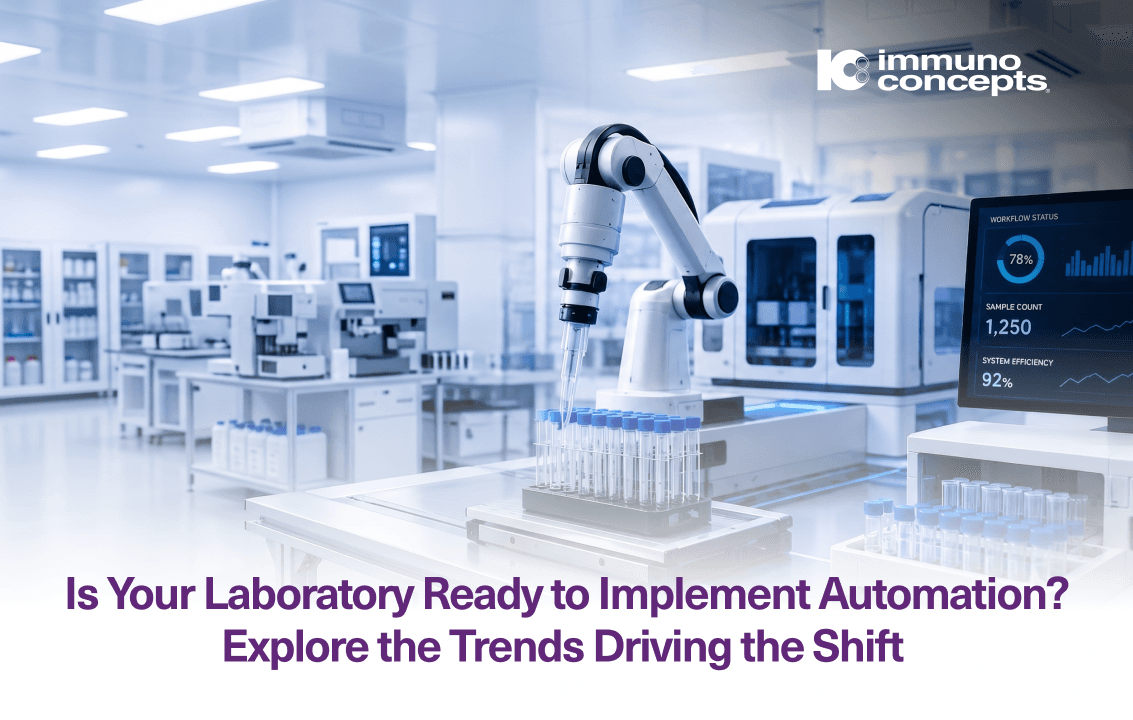
The future of clinical diagnostics is being shaped not just by what laboratories test, but by how efficiently they can test it. The global laboratory automation market was valued at USD 9.2 billion in 2025 and is projected to reach USD 20.71 billion by 2034, growing at a 9.43% CAGR.
This growth reflects a broader shift toward more connected, scalable, and adaptable laboratory operations.
For specialty diagnostics, this evolution is particularly relevant. Immuno Concepts is advancing automation for autoimmune testing with technologies that help laboratories deliver greater consistency and efficiency in complex testing processes. As these capabilities continue to develop, several lab automation trends are emerging that could shape how clinical laboratories operate over the next decade.
This article explores the key developments driving that shift and what they mean for the future of clinical diagnostics.
Why Clinical Laboratories Are Rethinking Automation
The growth of laboratory automation reflects more than technological advances. Clinical laboratories are managing higher testing demands while maintaining quality, meeting turnaround-time expectations, and using skilled professionals effectively. At the same time, not every diagnostic workflow presents the same automation challenge.
A high-volume chemistry workflow may be highly standardized, while specialty testing such as IFA can involve image acquisition, pattern recognition, and expert interpretation. In HEp-2 IFA testing, for example, the result is not limited to a positive or negative classification; fluorescence intensity, titer, and pattern can all provide clinically relevant information.
As these pressures converge, automation is becoming a strategic consideration across more stages of the diagnostic workflow.
Rising Testing Volumes Are Changing Workflows
As diagnostic testing expands, manual processes that once worked well at moderate volumes can become difficult to sustain. Repetitive specimen handling, pipetting, sorting, and data entry can consume valuable time while introducing additional opportunities for variability.
This challenge also extends to image-based testing. In autoimmune laboratories, increasing IFA volumes can mean more slides to process, scan, review, and document. When every stage depends heavily on manual intervention, increasing throughput can place additional pressure on laboratory professionals.
Automation in medical laboratory workflows can help laboratories:
- Standardize repetitive processes
- Reduce unnecessary manual handling
- Increase processing capacity
- Improve workflow consistency
- Support more predictable turnaround times
Workforce Expertise Is Being Used Differently
Automation is also changing how laboratory professionals spend their time. Instead of spending as much time on repetitive tasks, skilled personnel can focus on activities that require experience, judgment, and clinical oversight.
This includes:
- Quality assurance and control
- Troubleshooting and exception handling
- Result review and validation
- Complex diagnostic interpretation
- Workflow and process improvement
The goal is not to remove laboratory expertise from the workflow, but to redirect it toward higher-value responsibilities.
Complexity Is Expanding Beyond High-Volume Testing
Automation was once closely associated with standardized, high-volume workflows. That boundary is now expanding as specialty laboratories look for technologies that can accommodate different assay formats, workflow requirements, and testing volumes.
Autoimmune diagnostics demonstrate why flexibility matters. Laboratories may work across IFA, ELISA, and immunoblotting, with each methodology involving different processing and interpretation requirements.
IFA adds another layer of complexity because the output is an image rather than simply a numerical measurement. The laboratory may need to evaluate the location and pattern of fluorescence alongside titer and other findings.
This is driving demand for more flexible laboratory automation platforms that can:
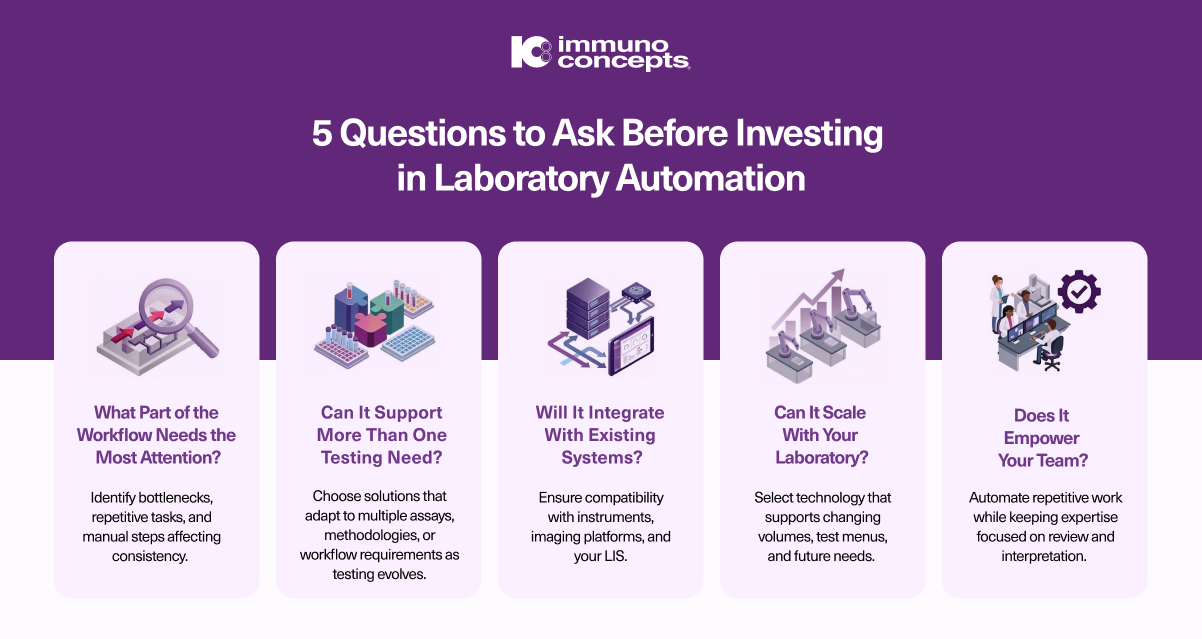
- Support multiple assay types
- Adapt to changing test volumes
- Integrate with existing laboratory systems
- Scale as testing requirements evolve
- Automate defined processes without sacrificing flexibility
These pressures provide the foundation for today's lab automation trends. From total workflow automation and AI-assisted analysis to robotics, connected systems, and flexible platforms, next-generation technologies are changing not only what laboratories automate, but how the entire diagnostic workflow is designed.
The Lab Automation Trends Defining the Current Era
Laboratory automation is evolving from individual task automation toward broader systems that can support increasingly complex diagnostic workflows. Four developments are particularly influential in this transition.
Trend 1: Total Workflow Automation Is Replacing Isolated Tasks
Early automation often targeted individual bottlenecks, such as pipetting, specimen sorting, or barcode identification. The focus is now shifting toward coordinating multiple stages of the testing process.
Instead of optimizing one step in isolation, total workflow automation considers the path from specimen receipt through testing and result release. This approach can prevent delays as samples move from one stage to another and places greater emphasis on interoperability between instruments and systems.
Trend 2: AI Is Supporting Automated Image Analysis
AI is becoming increasingly relevant to laboratory workflows that involve large volumes of images and complex pattern recognition. In diagnostic applications, AI-assisted technologies can support image classification, sample prioritization, and quality-control activities.
For laboratory professionals, the value lies in using these capabilities to support routine analysis while retaining expert oversight for findings that require further review or interpretation.
Trend 3: Connected Systems Are Improving Laboratory Visibility
Automation generates more data than individual instruments can usefully manage on their own. Connecting analyzers, imaging systems, laboratory information systems (LIS), and workflow software allows that information to move more effectively across the laboratory.
This can provide teams with:
- Better traceability across testing stages
- Fewer manual data-transfer steps
- More centralized access to workflow information
- Greater visibility into operational and quality metrics
Connectivity therefore becomes an important layer of modern laboratory automation, particularly for laboratories managing multiple instruments or testing methodologies.
Trend 4: Flexible Automation Is Supporting Diverse Test Menus
Laboratories do not operate with identical test menus, sample volumes, or workflow requirements. As a result, automation is increasingly moving toward modular and configurable approaches rather than fixed systems designed around a single operating model.
This shift is particularly relevant to specialty diagnostics, where laboratories may work across multiple assay formats, including IFA, ELISA, and immunoblotting. Adaptable laboratory automation solutions can help accommodate these requirements while providing room to expand as testing needs change.
The result is a more versatile approach to automation, one that considers not only how much a laboratory can process, but how effectively its technology can accommodate the complexity of modern diagnostics.
Bringing Emerging Automation Trends Into Practice
The evolution of laboratory automation becomes most meaningful when emerging capabilities translate into practical improvements within real diagnostic workflows. For autoimmune laboratories, this means having technology that can accommodate different assay formats while supporting the steps that require consistency, efficiency, and specialized expertise.
Immuno Concepts applies this approach across several areas of autoimmune diagnostics, reflecting key lab automation trends such as multi-assay processing, automated image acquisition, and greater workflow integration.
Automating Multi-Assay Pipetting
As laboratory automation moves toward greater flexibility, laboratories need systems that can support more than a single testing methodology. The DAS automated pipetting platform automates pipetting for IFA, ELISA, and Immuno Blot workflows on one customizable platform.
This allows laboratories to apply automated liquid handling across different assay requirements rather than building separate manual processes for each methodology.
Advancing Automated IFA Workflows
The growing emphasis on image-based automation is particularly relevant to IFA workflows. Image Navigator® automates slide scanning and image acquisition while supporting sample triage for review.
By bringing automated image capture into the IFA workflow, the system helps laboratories manage image-based testing more systematically while keeping laboratory professionals involved in the evaluation process.
Streamlining Critical IFA Processing Steps
Not every stage of automation in medical laboratory environments requires sophisticated analysis. Automating the right repetitive steps can also make a meaningful difference to laboratory operations.
The Autoimmune FastTrack (AFT) IFA Processor automates key IFA processes, including reagent handling and incubation. This reduces manual intervention during defined processing stages and supports a more standardized approach to IFA testing.
Together, these technologies demonstrate how automation can be applied across different requirements within autoimmune diagnostics, from liquid handling and IFA processing to automated image acquisition.
Rather than treating automation as a single technology, Immuno Concepts approaches it as a set of capabilities designed around the realities of autoimmune testing.
Gearing Up for the Next Chapter in Clinical Diagnostics
Lab automation trends are moving the industry beyond individual process improvements towards more scalable diagnostic environments. As testing demands evolve, laboratories will increasingly need technologies that can support multiple methodologies, improve consistency, and make better use of specialized laboratory expertise.
Immuno Concepts is helping advance this transition with automation technologies designed around the needs of autoimmune diagnostic laboratories. As the next generation of laboratory automation takes shape, the opportunity is not simply to automate more, but to build smarter testing processes that bring technology and human expertise together.