

By Nicole Lasquete/AUGUST 3, 2026
Clinical laboratories operate at the intersection of precision, speed, and volume. According to the World Health Organization (WHO), approximately 70% of clinical decisions are influenced by laboratory test results, underscoring the critical role laboratories play in disease detection, diagnosis, treatment selection, and patient monitoring. As diagnostic demands intensify globally, the question is no longer whether a laboratory should invest in laboratory automation; it is how quickly and how comprehensively that investment can be made.
From specimen handling to result reporting, automation in medical laboratory settings is fundamentally reshaping what is operationally possible while simultaneously raising the standard for diagnostic quality. Growing testing volumes, workforce shortages, increasing regulatory expectations, and the need for faster turnaround times have made clinical laboratory automation one of the most significant developments in modern laboratory medicine.
This guide explores what automation in clinical laboratory environments means in practice and how laboratory automation solutions, including those offered by Immuno Concepts, deliver clinical and operational value.
What Is Automation in Clinical Laboratory Settings?
Clinical laboratories depend on hundreds of interconnected processes every day. Ensuring that each step is performed accurately and consistently becomes increasingly difficult as testing volumes rise. Clinical laboratory automation helps laboratories address this challenge by replacing repetitive manual tasks with validated, standardized workflows.
Laboratory automation refers to the integration of instruments, software, robotics, and connected systems to perform laboratory processes with minimal human intervention. Clinical laboratory automation spans the entire testing workflow, including pre-analytical processes such as specimen handling and labeling, analytical activities such as assay execution and image capture, and post-analytical functions including result review, reporting, and data management.
Why Are Clinical Laboratories Accelerating Automation Adoption?
The shift toward clinical laboratory automation is being driven by a combination of operational, economic, and clinical pressures. Laboratories today are expected to process more samples, deliver faster results, and maintain increasingly stringent quality standards, all while managing workforce constraints and budgetary pressures.
These demands have transformed automation from a competitive advantage into a strategic necessity.
Rising Testing Volumes and Workforce Challenges
Healthcare systems continue to generate increasing diagnostic demand. Aging populations, the rising prevalence of chronic disease, preventive screening programs, and expanding access to healthcare services have all contributed to the growing laboratory workload.
At the same time, many laboratories face workforce shortages. Studies examining total laboratory automation consistently identify increasing test volumes and staffing challenges as primary drivers of automation adoption.
Supporting Laboratory Professionals
Automation changes how laboratory professionals spend their time. Rather than focusing on repetitive manual procedures, technologists can devote more attention to quality assurance, troubleshooting, interpretation of results, and clinical consultation.
This allows laboratories to maximize the value of highly trained personnel while improving operational performance.
Key Advantages of Automation in Clinical Laboratory Workflows
The advantages of automation in clinical laboratory environments extend beyond efficiency alone. Automation influences quality, consistency, throughput, staff utilization, and long-term scalability.
As automation becomes more deeply integrated into laboratory operations, these benefits often compound over time.
Improved Accuracy and Reduced Human Error
Automated systems execute procedures using predefined protocols, reducing variability between operators and across testing runs. This level of consistency helps improve reproducibility and supports more reliable diagnostic results.
Faster Turnaround Times
Turnaround time remains one of the most important performance indicators in laboratory medicine. By reducing manual handling and streamlining workflows, automation helps laboratories deliver results more quickly while maintaining quality standards.
Higher Throughput
An automated clinical laboratory can process substantially higher testing volumes without requiring proportional increases in staffing. This scalability becomes increasingly important as demand for diagnostic testing continues to grow.
Better Standardization
Automation helps ensure that testing procedures are performed consistently regardless of operator, shift, or location. This is particularly valuable for laboratories operating across multiple sites or processing high volumes of testing.
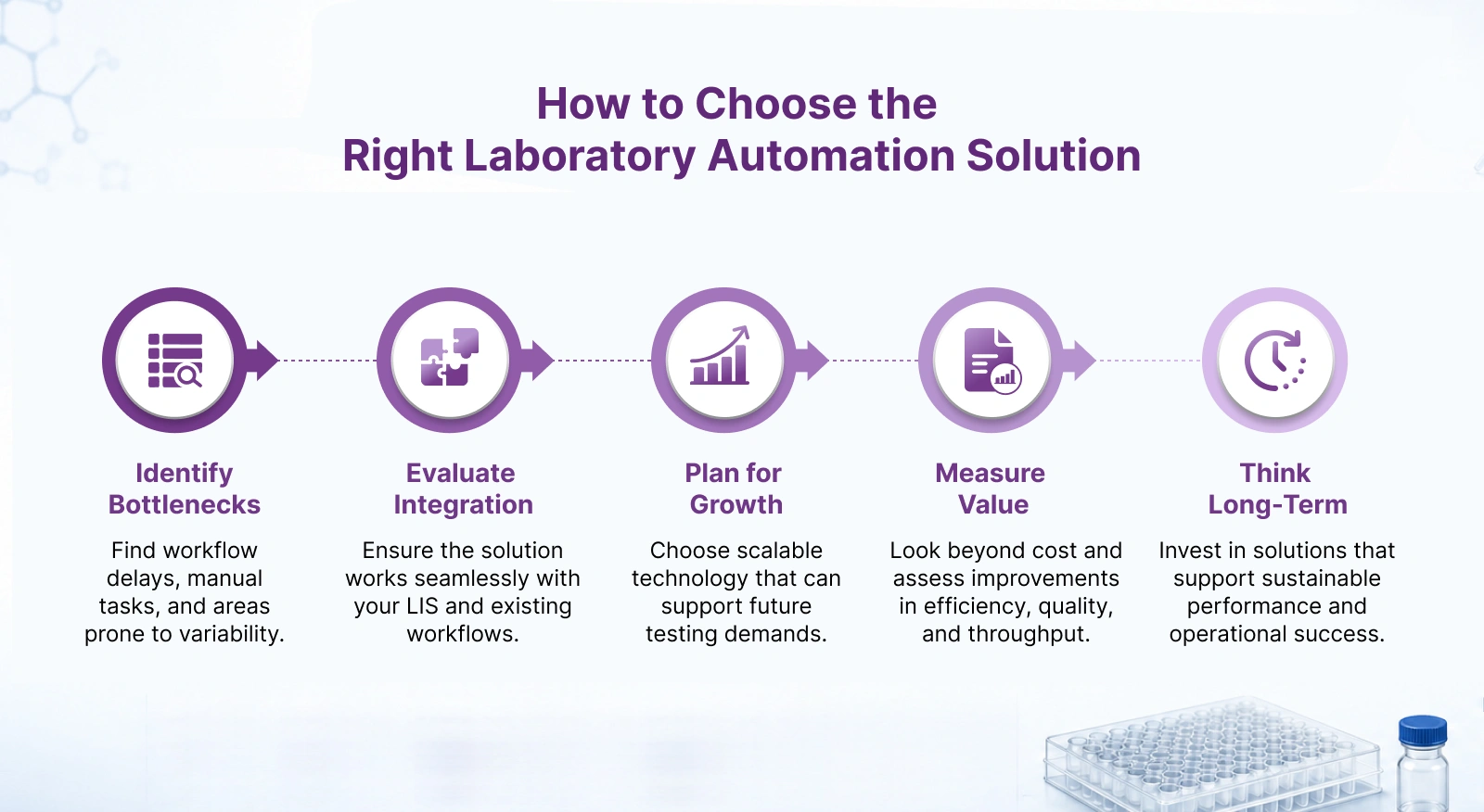
How to Choose the Right Laboratory Automation Solution
Before investing in laboratory automation, evaluate the factors that will have the greatest impact on long-term performance and workflow efficiency.
How Immuno Concepts Supports Laboratory Automation
As laboratories invest in laboratory automation solutions, the goal is not simply to increase throughput but to improve consistency, efficiency, and diagnostic confidence simultaneously.
Immuno Concepts has developed an integrated portfolio of automation technologies specifically designed to support autoimmune diagnostic workflows.
DAS Automated Pipetting Platform
The DAS automated pipetting platform automates pipetting across IFA, ELISA, and Immuno Blot workflows on a single customizable system. Integrated with Image Navigator®, it streamlines workflow continuity from sample processing to result reporting while supporting scalable, multi-assay testing for laboratories of varying sizes.
Image Navigator® Automated Microscope
The Image Navigator® automated microscope is designed to automate slide scanning, image acquisition, and sample triage. The system automatically captures high-quality fluorescence images and categorizes samples for review, helping laboratories improve efficiency while maintaining diagnostic oversight.
Autoimmune FastTrack (AFT) IFA Processor
The Autoimmune FastTrack (AFT) processor automates critical steps in the IFA workflow, including reagent handling and incubation. By reducing manual intervention, laboratories can improve consistency while increasing throughput.
RELISA® Test Systems for Quantitative Confirmation
Immuno Concepts' RELISA® test systems complement automated IFA workflows by providing quantitative confirmation of autoantibodies. These automation-ready assays support high-volume testing while delivering standardized, calibrated results suitable for disease monitoring and diagnostic confirmation.
Emerging Trends in Laboratory Automation
Laboratory automation continues to evolve rapidly as new technologies emerge. The next generation of clinical laboratory automation is expected to combine advanced instrumentation with artificial intelligence, predictive analytics, and increasingly connected data ecosystems.
These innovations will further improve efficiency, standardization, and decision support capabilities.
Artificial Intelligence and Image Analysis
AI-assisted technologies are increasingly being incorporated into laboratory workflows to support image interpretation, quality control, and result review.
Connected and Intelligent Laboratory Ecosystems
Cloud-enabled systems and integrated data platforms are helping laboratories improve collaboration, monitoring, and operational visibility.
Transforming Laboratory Performance Through Automation
Clinical laboratories are being asked to do more than ever before: process growing volumes of tests, maintain diagnostic quality, reduce turnaround times, and operate efficiently despite workforce challenges.
Laboratory automation has emerged as one of the most effective tools for meeting these demands. From specimen handling and image analysis to data management and workflow standardization, automation helps laboratories improve operational performance while supporting diagnostic confidence.
For autoimmune diagnostic laboratories, where complex testing workflows require both efficiency and expertise, the value of automation is particularly significant.
Immuno Concepts supports this evolution through integrated laboratory automation solutions designed specifically for autoimmune diagnostics. By combining advanced automation technologies with decades of expertise, Immuno Concepts helps laboratories build scalable workflows without compromising clinical quality.