

By Nicole Lasquete/SEPTEMBER 10, 2026
Autoimmune diseases affect an estimated 5-10% of the global population, driving a growing demand for accurate and reliable autoantibody testing. As laboratories process increasing volumes of autoimmune diagnostic tests, understanding direct vs. indirect immunofluorescence has become more important than ever. Although both techniques use fluorescent antibodies to visualize biological targets, they are designed for fundamentally different diagnostic purposes.
Direct immunofluorescence is primarily used to detect tissue-bound antigens or immune deposits, whereas indirect immunofluorescence is the accepted and preferred approach for detecting circulating autoantibodies in autoimmune diagnostics.
This blog breaks down the science, strengths, and limitations behind direct vs. indirect immunofluorescence so your laboratory can make an informed, evidence-based choice
What Is Immunofluorescence Testing?
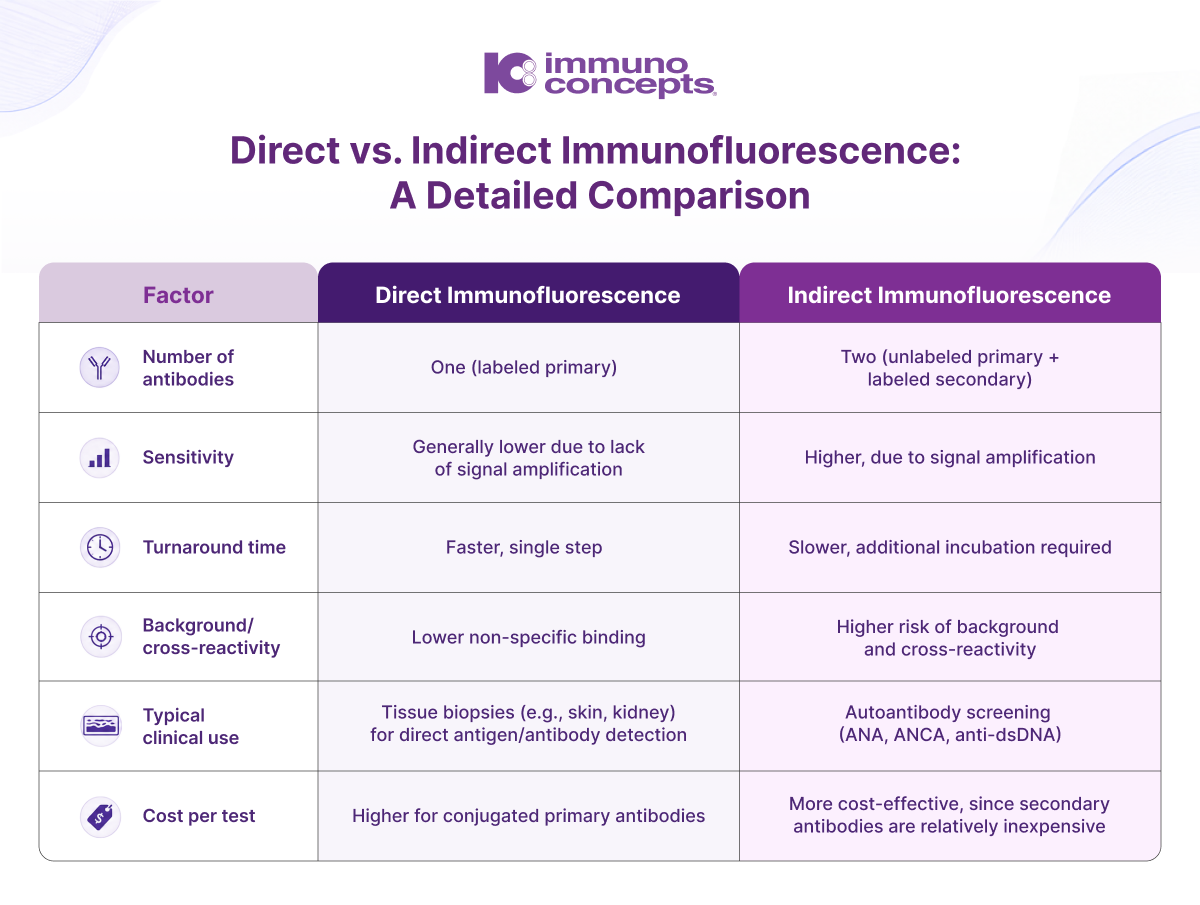
Immunofluorescence (IF) uses fluorescently labeled antibodies to detect and localize specific antigens within cells or tissues. Although both techniques use fluorescent antibodies to visualize biological targets, they are designed to answer different diagnostic questions. Direct immunofluorescence identifies antigens or immune deposits directly within patient tissue, making it valuable in applications such as dermatopathology and nephropathology. Indirect immunofluorescence, on the other hand, is designed to detect circulating antibodies in patient serum and is widely used for autoimmune disease screening and diagnosis.
Understanding this distinction is essential when evaluating direct vs. indirect immunofluorescence, as the two methods complement rather than replace one another.
Direct Immunofluorescence: How It Works
In direct immunofluorescence (DIF), the primary antibody itself is labeled with a fluorescent dye and applied directly to the slide, where it binds to the target antigen before being visualized under a fluorescence microscope. Since there is no secondary antibody step, the process is faster and involves fewer reagents.
Advantages of direct immunofluorescence:
- Simple, rapid, single-step protocol
- Reduced non-specific binding and lower species cross-reactivity
- Well suited to detecting highly expressed antigens, such as immune complex deposits in skin biopsies
Limitations of direct immunofluorescence:
- Weaker sensitivity compared to indirect IF
- Lower signal intensity, since there is no amplification step
- No multiplexing capability in a single conjugate
Indirect Immunofluorescence: How It Works
Indirect immunofluorescence (IIF) adds a second layer to the process. An unlabeled primary antibody binds the target antigen first, and a fluorescently labeled secondary antibody is then applied to detect the primary antibody. This two-step design is the basis for most autoantibody screening assays used in autoimmune diagnostics today, including ANA, ANCA, and anti-dsDNA testing.
Advantages of indirect immunofluorescence:
- Signal amplification, since more than one fluorescent secondary antibody can couple to a single bound primary antibody, increasing sensitivity over direct IF
- Commercially available, ready-labeled secondary antibodies that are easy to source
- Flexibility to detect multiple primary antibodies using the same labeled secondary antibody, which makes it more cost-effective across a broad testing menu
Limitations of indirect immunofluorescence:
- Potential for cross-reactivity and higher background staining, particularly when endogenous immunoglobulin is present in the target tissue
- Longer processing time due to the additional incubation and wash step
- Greater dependence on operator technique and slide interpretation
Why Is Indirect Immunofluorescence More Sensitive?
One of the key advantages of indirect immunofluorescence is signal amplification. Since multiple fluorescent secondary antibodies can bind to a single primary antibody, the fluorescence signal becomes stronger, making low-abundance antibodies easier to detect. This increased sensitivity is one of the primary reasons indirect immunofluorescence remains the preferred approach for autoimmune antibody testing.
Direct vs. Indirect Immunofluorescence: Which Technique Fits Your Application?
When comparing direct vs. indirect immunofluorescence, the most important question is not which technique is universally better, but what the laboratory is trying to detect.
Choose direct immunofluorescence when the goal is to identify tissue-bound antigens, target proteins, or immune complex deposits directly within patient specimens. Since the fluorescent label is attached directly to the primary antibody, the technique provides rapid visualization with minimal background staining, making it well suited for tissue-based diagnostic applications and certain research settings.
Choose indirect immunofluorescence when the objective is to detect circulating autoantibodies. The additional secondary antibody provides signal amplification, improving sensitivity while enabling laboratories to identify a broad range of clinically significant fluorescence patterns. This makes indirect immunofluorescence particularly valuable for autoimmune diagnostics, including ANA, ANCA, and anti-dsDNA testing.
Rather than competing techniques, direct and indirect immunofluorescence are complementary methodologies designed to answer different diagnostic questions.
Immuno Concepts focuses exclusively on autoimmune diagnostics and antibody detection; every immunofluorescence assay in our portfolio is built on the indirect immunofluorescence principle. This approach provides the sensitivity, reproducibility, and fluorescence pattern recognition laboratories rely on for confident autoimmune disease diagnosis.
Aligning Immunofluorescence with Diagnostic Goals
Direct vs. indirect immunofluorescence is not about choosing one technique over the other; it's about selecting the right methodology for the diagnostic objective. As autoimmune testing continues to evolve, laboratories need testing methods that deliver consistent performance, reliable fluorescence patterns, and reproducible results.
For more than four decades, Immuno Concepts has helped laboratories meet these demands through validated indirect immunofluorescence assays designed specifically for autoimmune diagnostics. Whether supporting routine ANA screening or complex autoimmune testing workflows, our solutions provide the diagnostic confidence laboratories depend on.
In diagnostics, accuracy matters. Discover how Immuno Concepts can support your laboratory with trusted indirect immunofluorescence solutions.